

How to Make Almond Paste

This post may contain affiliate links, including those from Amazon.com, which means we earn a small commission off your purchases. And here's the thing: We only mention services and products that we think are truly worth your attention, whether they're free, paid, or otherwise. This site relies on YOUR trust, so if we don't stand behind a product 110%, it's not mentioned. Period.
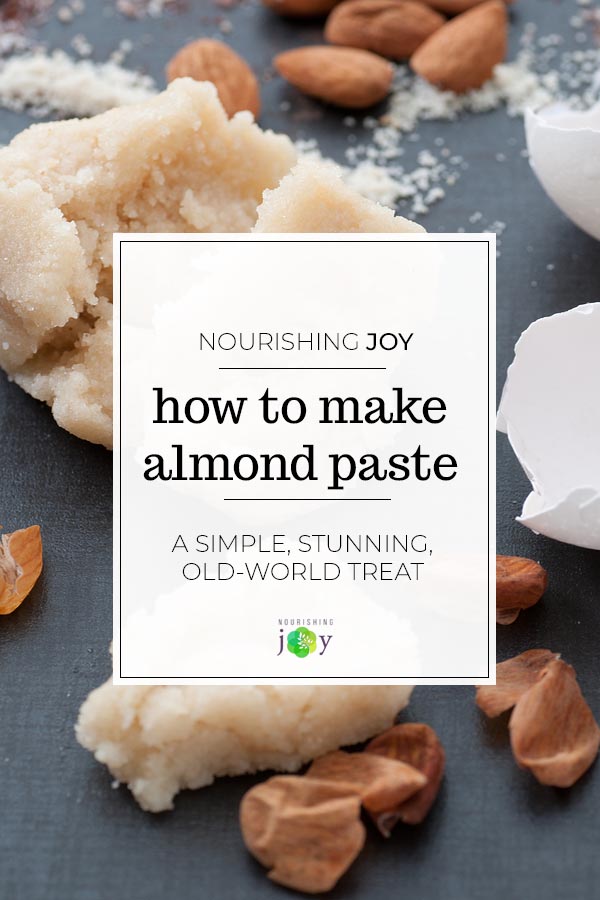
Almond paste is an absolutely ubiquitous, don't-you-dare-not-have-it pantry staple in our house around Christmas time. Between the Dutch, Swedish, and German heritages that make up our family, almond paste shows up in a whoooooole lot of traditional Christmas recipes.
The problem is – and yes, you've heard this before – it uses refined sugar. A lot of it.
So, what to do when you're planning on giving in to the aforementioned love of almond paste and eating copious amounts of it? You find a method that allows you to use a sugar that's not highly refined.
Yes, you're still eating sugar, and yes, that definitely means some modicum of moderation should be called for, but you will be reducing the absolute havoc that is wreaked upon a body by ingesting highly refined sugar.
But all preaching aside, this method of making almond paste is simple and stunning. In my estimation, it makes a far superior paste to the egg-and-powdered-sugar version that I've made in the past. This tastes like it came straight off the confectioner's worktable in the old-world and it's just the right texture to knead and shape as desired.
And one note about using both sugar and honey – I've tried the recipe using various amounts of each, including JUST sugar or JUST honey, but definitely the best texture and best moisture is found with the ratio used here.

Old-World Style Almond Paste
Equipment
- Food processor
Ingredients
- 250 grams (~1 2/3 cup) whole, blanched almonds
- 125 grams (~9 tablespoons) unrefined cane sugar
- 37 grams (~2 tablespoons) honey
- 45 grams (~3 tablespoons) water, more as needed
- 2 teaspoons almond extract OR cherry extract (optional)
Instructions
- If your almonds aren't pre-blanched, blanch them (see directions below).
- Place the almonds in a food processor and grind until they are the size of very coarsely ground coffee. Let sit until the sugar mixture is ready.
- Place the sugar, honey, and water in a medium saucepan and bring to a full, rolling boil over medium-high heat. While it's still boiling, pour the syrup over the almonds, then process until smooth, which usually takes 5-10 minutes.
- At some point in the first few minutes of grinding, add the almond extract through the feed tube so that it gets thoroughly worked into the dough.
- If the dough isn't cohesive after processing for several minutes, add more water 1 teaspoon at a time, letting each addition get fully worked into the dough before adding more.
- Remove the almond paste from the processor and wrap it tightly in plastic wrap or a damp tea towel (although it will likely stick a bit to the tea towel - be forewarned). Place in the refrigerator until fully chilled, then use as desired.
How to Blanch Almonds
- Bring a large saucepan of water to a boil, then add any amount of raw almonds. Let the almonds simmer for about 60 seconds, then drain them and run them under cold tap water to stop the cooking process and completely cool them. Pour them out onto towels and pat them dry. At this point, you should notice the skins beginning to shrivel, so at that point, squeeze and rub each almond gently until the skins begin to peel off. Use the blanched almonds immediately or store them in an airtight container in the freezer for up to 6 months.
Notes


Is this the same thing as marzipan?
Well, no, but…. 😉
The real answer should be “no,” as marzipan has as higher sugar content than almond paste and is generally more pliable, which you can achieve by increasing the amount of sugar in the syrup, kneading in a bit of butter, and/or by adding a raw egg white in the blending stage. In Germany, there are even laws governing that marzipan can only be called “marzipan” if it is a strict ratio of two parts sugar to one part almonds (!), with rose water as the only legal additive (as opposed to the almond extract I’ve called for here, since I love a strong almond flavor).
The reason I add the caveat of “yes,” however, is that for most home cooks, there’s not much distinguishable difference. In the professional food world, there are many different definitions of what can be considered marzipan – there’s British marzipan, French marzipan, German marzipan, Danish marzipan, and who knows how many other variations, but at home, it just depends on what you want to do with it. Most of the time, almond paste is used as an ingredient inside various baked goods, whereas marzipan is used as decoration on the outside, either rolled out like fondant or shaped and painted like little sculptures (which I have no patience for, personally – heh).
If you want to use this recipe as marzipan, I would add 150 g of sugar and 25 g of honey without increasing the amount of water. Then, grind it absolutely as fine and smooth as possible without burning out your food processor.
I imagine Finns use a fair bit of almond paste, since Sweden, Norway, and Denmark all use copious amounts. Is there a consensus there about how almond paste is used?
Wow, you really know a lot about this! Thank you for the very thorough explanation. Finnish food is quite different from the food of the neighboring Scandinavian countries. I see marzipan at the grocery store (or almond paste – i’ll have to check), but I haven’t noticed it used in any baked goods. I’ll have to look up some recipes, though. Thanks again!
Well, I do love my almond paste. 😉
I’ll look forward to hearing how your recipes go. If you ever post any of them up on your site, let us know!
Real Food Suomi
I was wondering.. can I use blanched slivered almonds in lieu of whole almonds? How many cups would I use?
Thank you very much for your assistance!
Absolutely! Any almonds will do. Just go by weight – the amount you need by weight will never change, no matter how the almonds are cut. 🙂
However, if you don’t have any way to weigh the almonds, slivered almonds have a conversion of about 1 cup = 110 grams, so you’d need about 2 1/3 cups for one batch of this recipe.
I hope that helps! 🙂
I love Almond Paste! Since I am on a restricted diet, can I use Stevia instead of sugar? What about coconut sugar? Thank you!
Celeste,
Thanks for a great question! I would think coconut sugar would work just fine, but I imagine the stevia would give a bitter edge to it when using that large a quantity. Also, simple syrups made with anything other than a granulated sugar like cane sugar or coconut sugar don’t tend to turn out very well….
Good luck!
Thank you so much for this recipe! Do you know about how many ounces of paste it makes in the end? I use quite a bit making Italian desserts at Christmas, so nice to find a healthier version!
Well, the recipe makes about 2 pounds, so that would be 32 ounces.
Hope that helps! 🙂
Hi. I live in a small city in China, and I don’t think I can find unrefined cane sugar (and almond extract, but that’s for flavor, yes?). Can we use any kind of sugar, or is cane sugar a must? Also, do you think I could I use (natural) maple syrup as a honey substitute?
Thanks.
Yes, you can absolutely use regular sugar or whatever crystalline-structured sugar you can find. Darker sugars may change the flavor slightly, but not in an undesirable way, per se. The almond extract is optional just to give it a more potent almond flavor.
I haven’t tried the maple syrup, but my gut instinct is that it will make the mixture a bit too soft. However, like I said, I haven’t tried it, so it might work beautifully (as well as give it a lovely maple flavor – yum!).
I subbed maple syrup for the honey and it came out great. I let the syrup/sugar mixture boil for just a minute to cook up a little extra liquid. I then used it in this recipe: http://www.theppk.com/2013/03/mini-almond-poundcakes/ Yum!
Kresha,
Do you have a good recipe for German Christmas Stollen or Lebkuchen?
Cheers Lulu
Yes! I’ll be posting our sourdough stollen recipe in December. Stay tuned in our newsletters or on Facebook to know when it’s live. 🙂
Sign up for our newsletter –> http://eepurl.com/gPi8f
See us on Facebook –> https://www.facebook.com/nourishingjoy
Hello,
Thank you for sharing this. I wondered how long the marzipan lasts for and can it be left at room temp
Thank you.
Yes, this can be left at room temperature, covered, for about 3-4 days. (I say “covered” merely because sweet things tend to attract bugs…..)
I’m not sure how long it lasts in the refrigerator, however. I usually use mine up within two weeks, but I would imagine it would keep just fine for about 3 months in the refrigerator and about 12 months in the freezer if it’s wrapped tightly in plastic wrap or other airtight seal.
Kresha, since we’re grinding up the almonds anyway, could I use blanched almond flour? Thanks.
Yes, absolutely! I just find the flavor isn’t as “fresh,” but it definitely make the process fast. 🙂
Thank you, thank you!
What would the 3 1/2 Cups of blanched almond measure in ground almonds? I’m buying my almonds already ground up.
Well, almond flour varies in fineness WILDLY from brand to brand, and thus, the volume changes too. The 500 grams of whole almonds called for here can render anywhere from 3 1/2 cups to 5 cups of ground almonds, depending on how finely your almond flour/ground almonds are ground.
To measure by volume, I would recommend starting with 3 1/2 cups of almond meal, then after adding the honey syrup and processing for a few minutes, if the mixture is still quite sticky and not pulling itself off the walls of the food processor, then adding more almond meal 2-3 tablespoons at a time until the mixture is still soft but not sticky.
I hope that helps!
I using almond meal idnt that the same as grinding up almonds with the skin? Almond meal has brown specks in it.
Yes, exactly. Almond meal should work just fine, even though the skins are ground as part of it. The only “downside” is that your final product might have micro-flecks in it too, but taste-wise and function-wise there shouldn’t be any difference. 🙂
Is it imperative that the almonds are blanched?
Well, you could use almonds that still have their skins if you really want, but both the flavor and texture will be different. Not necessarily a “bad” different, just different. The skins will impart a slightly more bitter and toasted flavor and will fleck the dough with dark specks. The almond flavor, however, may be deeper due to the flavinoids and slight bitter edge of the skin.
Basically, no, you don’t HAVE to use blanched almonds, but the final flavor and texture will be smoother, sweeter, and more traditional if you do.
Does that help?
I just got 50 lbs. of fresh raw almonds sent to me by my in-laws from their first harvest on their new almond farm in CA. I need to find something to do with a lot of almonds. I don’t have a food processor (except a mini-prep.) Could I use my Vitamix blender to grind the almonds? Should I do small batches in my mini-prep, or find someone who has a food processor and borrow it? Thanks!
That’s a great question!
I would think it would become a frustratingly laborious task to do them in the mini-prep. You could likely do them in the Vitamix with no problem, but they might cloud up your blender jar, as hard items tend to do as they nick the insides, leaving a cloudy appearance.
Thus, I think your best bet is to borrow a larger food processor, if that’s possible.
Good luck and have fun!
Thank you for sharing this! I am curious if I could use almond flour I stead of blanched? Particularly for a fine paste. What do you think?
Yes, that should be fine as long as your machine can grind it into a paste. 🙂
Enjoy!
Just FYI, this recipe totally burnt out my food processor! Might want to add a warning at the top…
Thanks for letting us know! And I’m so sorry – it’s so frustrating when that happens.
That’s interesting – I’ve made hundreds of batches of this with never a problem. (With other recipes, if it gets hot while processing, I just turn it off and let it cool before continuing.)
Out of curiosity, what size food processor do you have? That way if others have the same size, they can be aware.
Thank you!
WHAT ABOUT USING CONFECTIONERS SUGAR IN PLACE OF REFINES CANE OR BEET SUGARS?
Well, confectioner’s sugar IS refined or beet sugar – it’s merely any type of granulated sugar that’s ground until it’s powdered, and most of the conventional brands are “regular” refined white sugar.
But as for whether or not it will work in the recipe, you could certainly try it, as the sugar is dissolved into a syrup before it’s used in the recipe, and confectioner’s sugar may work in that context, although I haven’t tried it, so I can’t give a definitive answer. However, if you do decide to try it, you MUST measure the sugar according to weight, as the volume will be very different from a standard granulated sugar.
So, I hope that helps! 🙂 Have fun!
Can the almond paste be kept in freezer when not in use?
Yes! You’ll just need to allow time for it to thaw so that it’s pliable before using.
Hi Kresha,
Just wondering, how does this almond paste hold up when used as
a filling? ie, banket or as it is sometimes commonly called, dutch letters?
Thanks ever so much for the recipe! Can’t wait to try it!
This almond paste holds up very well, although you might want to go a bit light on the honey, as fillings tend to work best with as dry an almond paste as possible (without being crumbly, of course).
Dutch letters are one of my absolute favorite treats, so I hope this recipe serves you well. <3
Enjoy!
Can this recipe be used to make frangipane?
Yes – absolutely!
Made this tonight with sliced, unblanched almonds. Simply because that’s what I had at home and it does not necessarily need to be white for the frangipan pear tarts I will be making for Thanksgiving. I love the more “rustic” look to it with the brown specks and I hope the richness of flavors will be highlighted with a touch of rum. I made the full amount, even though I only need half, so that I can have a reserve in the freezer. Thank you for a wonderful recipe!
I’m so glad! I love the “rustic” touch you describe – that sounds delicious!
Jsylliaasen@alliancecom.net. My almond paste is dried out.Can I refresh it with some honey?
Hmm…. I would try kneading it with water one tablespoon at a time first and add honey only if it becomes crumbly.
I hope that helps!
I used your recipe to make marzipan fruits( yes, I’m one of those,lol) and they turned out great. I used ground almond flour and local honey. I made pears, oranges, strawberries and apples…about eighty in total. Can’t wait to gift wrap them!
WOW! Those sound AMAZING!! I adore marzipan and am in awe of anyone who can create those fun fruits and designs – and I’m so glad our recipe worked well for you. You’ve now inspired me to try something new… 🙂
Merry Christmas!
Thank you for the recipe. I have my own almond tree here in California so now I have a great recipe from you to use all my almonds! I love your website. God bless you and yours and thanks for all the great recipes and information you provide.