

Homemade Cough Drops

This post may contain affiliate links, including those from Amazon.com, which means we earn a small commission off your purchases. And here's the thing: We only mention services and products that we think are truly worth your attention, whether they're free, paid, or otherwise. This site relies on YOUR trust, so if we don't stand behind a product 110%, it's not mentioned. Period.
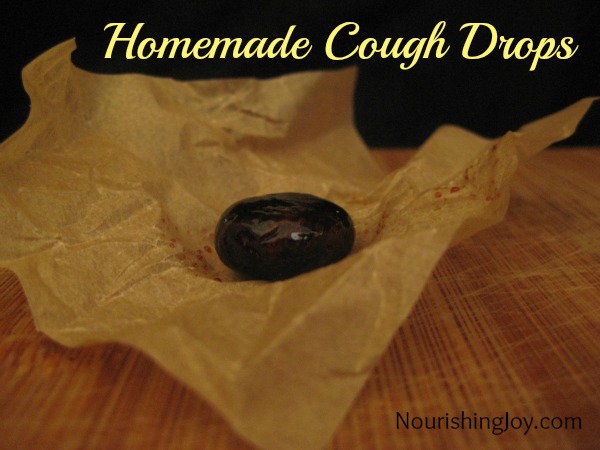
I love reverse-engineering.
(Heck… I've written two entire books about homemade pantry staples by reverse-engineering store-bought condiments – I must love it!)
But the day I realized I could reverse engineer our favorite Swiss-made herbal cough drops, I just about swooned.
And fortunately, they're easy. They do take a bit of time and they do take a bit of forethought if you don't already have the herbs on hand, but when you get to actually making them, they're pretty darn simple. Thankfully, that's just my style.
The recipe is customizable, too, so feel free to substitute other herbs you feel would work well for you in your particular situation. For example, if your child is fighting flu-like symptoms, you may want to up the elder flowers, or if you're pregnant, you may want to skip the hyssop and horehound. Use whatever works for your situation – just remember that herbs can be powerful and potent, so ask an herbalist if you've got any questions.
Are you as excited about natural remedies as I am?
Grab a copy of my book, The Thinking Parent's Guide to Natural Remedies, and it will quickly become your go-to reference guide anytime your child has a sore throat, earache, or comes down with the dreaded measles. Grab your copy here.
FRUGAL TIP: None of these herbs are terribly expensive, but even little things can add up. If you want to make these cough drops as inexpensively as possible, choose just 1 herb to use or use half the amount of herbs to steep the decoction. Even just plain honey without herbs can be soothing to suck on when you have a sore throat, so feel free to minimize this recipe if needed!
We have an herb-free homemade cough syrup if you'd prefer!
Also, our friends Tamara and Kelly came up with this fantastic natural cough remedy that you rub on your feet. And yes, it works! (Talk about a great way to soothe sniffly babies…)
Homemade Cough Drops
2 1/2 cups dried herbs (see below for one recommended blend)
1 cup water
1 1/2 cups honey
2-3 tablespoons olive oil
Optional Ingredients:
10 drops peppermint essential oil
5 drops lemon essential oil
5 drops menthol (where to buy menthol)
1-2 tablespoons butter (in case honey begins to scorch)
50 grams slippery elm bark powder (~1 cup) (where to buy slippery elm bark)
Cough, Cold, and Flu Herb Blend:
25 grams elder flowers (~2/3 cup) (where to buy elder flowers)
15 grams horehound (~1/2 cup) (where to buy horehound)
10 grams hyssop (~1/2 cup) (where to buy hyssop)
5 grams lemon balm (~1/4 cup) (where to buy lemon balm)
10 grams spearmint (~1/2 cup) – optional (where to buy spearmint)
Stir water and dried herbs together in a large saucepan, then bring to a steady simmer over medium-high heat. Reduce heat to medium-low and continue to simmer, covered, for 30 minutes.
Remove the decoction from the heat (yes, that's a word) and let sit until it's cool enough to touch. Strain off 1 cup of liquid, squeezing the herbs if necessary.
Return liquid to the heat in a clean, wide saucepan. Add the honey and bring to a boil over medium-high heat. Stir frequently and continue to cook until the liquid reaches 300° (hard-crack stage), a process that can take more than 1 hour, depending on the size of your pan. Watch the syrup very carefully toward the end, lowering the heat if necessary and stirring constantly to prevent burning. If you smell scorching before the syrup has reached 300°, stir in 1 tablespoon of butter to help stabilize it. Stir in the essential oils and the menthol (if using) just as the syrup reaches 300°.
Grease a baking sheet with the olive oil ahead of time and have it sitting at the ready. When the syrup is at hard-crack, pour the syrup into the baking sheet, and let it cool just until it can be handled by hand. Using greased hands, roll the syrup into lozenges and set aside on a lightly greased plate to harden completely.
If you live in a very moist climate, your cough drops may weep. (Don't ask me how I know…. ::sigh:: ) In that case, dredge them generously in slippery elm bark powder before moving them to long-term storage or change the recipe to use half honey and half brown rice syrup, which is less prone to softening when exposed to humidity.
Store in an air-tight jar. Keeps for 3-6 months in dry conditions.
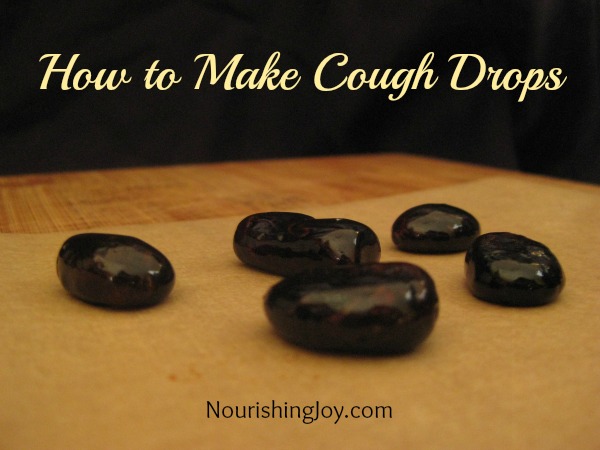
Know Your Herbs
Elder Flower
Native Americans have used various parts of the elderberry tree to treat fevers and joint pain for hundreds of years, but elderberry's real claim to fame is as a cure for the flu. According to Mountain Rose Herbs, Israeli researchers have developed five separate formulas based on the elderberry that have been clinically proven to prevent and ward off all kinds of influenza AND elder berries are known to be effective against eight strains of influenza [emphasis mine], which suggests that elder might even surpass vaccines for efficacy in preventing the flu.
Horehound
Horehound is in the mint family, but has a distinctively bitter taste. Its role here is as an expectorant and mild pain reliever, which are only effective if the bitter taste is present, interestingly enough. Also, if you use exclusively horehound in this recipe, it can help with nocturnal acid reflux, as it stimulates the release of phlegm, gastric acid, and other mucuses.
Hyssop
Hyssop is also part of the mint family and is used in herbal medicine to excrete excesses of fluids or mucus and as a vasodilator, thus assisting with breathing problems, such as asthma. Thus, I've included it in this recipe as an excellent expectorant and to help relax the laryngeal muscles if coughing has been excessive. It is an especially potent herb and is not recommended while pregnant or by anyone prone to seizure.
Lemon Balm
Lemon balm is yet another mint, this one with a distinctly lemony scent. In these cough drops, lemon balm provides a pleasant flavor and relief for itchy throats. If the cold is accompanied by fever, lemon balm will assist in breaking the fever, as well. It's also a mild anti-viral herb, so it can help ward off a cold if taken early.
Peppermint Essential Oil, Lemon Essential Oil, & Menthol
The essential oil of peppermint is known for easing digestion and helping with respiratory issues. I've added it, however, largely for the clean, fresh taste that helps offset the bitter edge, and for the vapor aroma that can help clear stuffy nasal passages. Lemon Oil is refreshing, invigorating, and tasty. Menthol is a natural topical pain reliever, so is helpful if the throat is painful due to excessive coughing or hoarseness, but it also is vastly useful as a decongestant.
Use all sparingly.
Honey
As I wrote in my original cough syrup recipe, honey is soothing, tasty, and coats the throat. Raw honey, especially, is packed with nutrients and enzymes and is a powerful antiviral and antibacterial substance, although in this recipe we take it to such a high temperature that most of those benefits are lost.
The beauty of the honey in this recipe is that it sweetens the drops (absolutely necessary with the bitter herbs!) and due to its sugar content, can be a natural substitute for refined sugar syrup in the candy-making process that makes these cough drops turn out like hard candies. Even the commercial brand of throat drops I reverse-engineered for these homemade cough drops uses sugar syrup, but honestly, the honey is so much more soothing on an achy throat.
Slippery Elm Bark Powder
Slippery elm bark powder turns into a sweet, mucilaginous slurry when combined with water and relieves inflammation and irritation in the throat superbly. While not an official ingredient in these drops, slippery elm is quite helpful if you need to keep your cough drops from sticking together (and don't want to take the time to individually wrap 100 lozenges in parchment paper) and its healing properties certainly offer a welcome addition to the goodness of these drops.
It has occurred to me (and this is completely untested, so please leave a review if you try this!) that if slippery elm is unavailable, acerola cherry powder might also make a good dredging option. Acerola powder is the most potent and concentrated source of Vitamin C currently known and might offer a desirable flavor. Again – just an idea. Let me know if it works (or is a horrible disaster…)
One note about boiling the herbs – typically the technique of boiling is reserved for hard plant materials, such as roots and wood, while softer materials, such as leaves, are treated more gently by steeping them for long periods of time.
The reason I call for boiling the leaves in this recipe rather than steeping is specifically to extract the bitter, healing elements. Yes, the herbs' water-soluble vitamins are lost because of this, but for our purposes, the herbs are much more potent when the bitter elements are present – especially in the case of horehound – so simmer away guilt-free. And don't worry – considering we're pairing the herbal extract with a super-sweet honey syrup, the bitterness won't be overwhelming.
If you'd prefer, you can infuse the herbs overnight: Place the dried herbs in a bowl and set aside. Boil the water, then pour over the herbs. Cover the bowl with a plate or lid and let sit for 8-10 hours. Strain well and continue as directed.
Here's to your health! May joy and good health be nourished in your home!

This post has been shared at Simple Lives Thursday.


This is awesome. Very excited to try it!
I love making cough drops at home, matter of fact, I just bought small honey candy drop molds so that I can just pour into them. As for the weeping due to humidity, the best time is when the humidity is less then 50%. I have been making candy for many years and that is the trick. Another trick is a dehumidifier aka, air conditioner in really humid weather. Thanks for the recipes, it is definitely an empowering when you can do for your self and with less preservatives and junk.
Candy molds – what a great idea! I’ve also heard of using lollipop molds, but candy molds would be even easier. Easy is good. 🙂
And thanks so much for the tips about humidity. I live in a temperate rainforest, so our relative humidity is usually around 80%, even in the winter. My soap tends to weep when it’s curing too, so I may have to use your dehumidifier tip for that as well.
Thanks!
Hi. I really want to try these, but have a few questions. Once they are done, how do you store them? In the fridge? In the cupboard? etc.. Also, how long do they last? Can I make them now and not use them for two months? I don’t have much time so like to make ahead, but if they have to be made and used right away, this may not work for me.
Thanks…I appreciate your answers.
zachsmama03 🙂
Zachsmama03,
There’s no need to store them in the refrigerator – in a cupboard or closet is fine. A more important factor is keeping them dry or, like any other cough drop, they start sticking together or softening, so if there’s a cupboard or shelf in your house that doesn’t get regular moisture (like from the shower) that would be the best place to keep them. They should last at least 3-6 months in dry conditions, so absolutely feel free to make them ahead.
Have fun!
where does one buy lozenge molds?? or jelly bean molds?
You should be able to find them at any craft, candy, or cake supply store, or I’ve seen them on Amazon.com. 🙂
Have fun!
I have been looking for MONTHS for a website like yours.. I found it googling homemade cough drops and I am SO pleased with all the things you have done that I have been looking to do! Thank you!!
Thank you, Sam. I’m so glad you’re here! Welcome. 🙂
If u don’t have candy moods u can also use a rimmedmbaking sheet, and fill it half way up the edges with icing sugar. Use your thumb or the bottom of a bottle of food colouring, to stamp dents into the icing sugar. Pour candy into the holes and alow to dry. When dry, toss the drops in the sugar which will prevent sticking.
I’ve made these several times now and love them! I inhaled some saw dust last October and spent months trying to recover – long story – just know that I don’t think I could have made it without these (I’m barely exaggerating).
I freeze my cough drops until I need them. Then they don’t get soft.
Brilliant! Thanks for sharing!
Thanks so much for sharing the cough remedy for rubbing on feet! It has helped my son sleep after 2 nights of not sleeping because of a bad cough! Wonderful!!
I’m so excited to try these to hand out at Christmas this year to neighbors and co-workers. I was able to get everything through Mountain Rose Herbs (yeay!) but they’re out of Hyssop so I’ll have to look elsewhere – boo :(. I’m wondering though, after you boil the decoction, what is the importance of straining off 1 cup of liquid? – what do you do with that extra cup? Wouldn’t it be just as effective to boil less water to begin with? I’m confused.
Actually, the one cup of liquid isn’t extra – that’s all we put in to start with. Sometimes I even have trouble squeezing out that much since the herbs absorb quite a bit! Basically, you’re just taking one cup of water, infusing it with all the goodness of those herbs, then straining it off to make the recipe.
I hope that helps!
By the way, if you’re going to make a whole bunch of these as gifts, I would definitely make a test batch first, both to test how they function in your climate and to verify that *you* like them. They’re rather strongly flavored. If they stay hard and you like them, they’re definitely a GREAT gift item, but you may need to troubleshoot if you live in a humid climate. Commercial cough drops use a sugar syrup rather than a honey syrup specifically because it is more shelf-stable in multiple climates. 🙂
I live in a VERY dry climate and I purchased some candy wrappers to individually wrap them up in, but I’m thinking I might tell the recipients to keep them in the freezer like the person above mentioned just in case. Test batch definitely seems like the way to go. Oh right, 1 cup to begin with, I was thinking of the dried herb quantities – Doh! Thanks again and Happy Thanksgiving!
Would these be safe to give to children? Thanks!
From an herbal standpoint, yes, they’re safe to give to children. Just treat them like any medication and don’t let them eat them like candy. 😉
And from a choking standpoint, yes, you may certainly give them to children who are old enough to handle any other cough drop or hard candy, but personally, I wouldn’t give them to anyone under three and only with extreme caution to my 4-5 year olds.
I hope that helps!
Thank you for the helpful tips, especially the one for butter to stabilize the honey and prevent further scorching. I too like to store my cough drops in the freezer, they seem to last longer.
I’ve made a lot of homemade herbal cough drops. An herbal mixture I like for both benefits and flavor is mullein, cedar berries, and mint. I’ve given them to people who have chronic problem with their breathing and they LOVE them. They are also the only thing that got me through 10 work shifts when I got sick.
Mullein (a.k.a. nature’s toilet paper or Indian toilet paper) helps the sinuses drain and stay clear, and help you focus. It grows wild all over the state I live in, so I find it for free. I don’t think it gets as much credit as it deserves for it’s many MANY benefits because it is seen as a weed. Personally, I found mullein was able to keep my sinuses drained and clear for eight hours after I had a few of my cough drops (I could tell when it wears of because I quite suddenly get stuffed up again)
Lenora, how do you harvest and use the mullein?
I thought adding some lemon juice to the recipe would be a good idea, but now I can’t get it to harden! I’ve brought the mixture to 300 degrees and was afraid it would scorch. Is there anything I can do to save this honey mess I have?
How do you know it won’t harden? Have you already poured it out and it’s not hardening in the pan or when you try to roll it?
The times that has happened to me, I use it as cough syrup. 😉
Out of curiosity, how much lemon juice did you add?
Yes, I tried pouring it out and it wouldn’t harden. But the thought of all that beautiful raw organic honey not working out right made me frustrated! So, I put the whole pan in the fridge for a while to harden, then put it back in the pot – with some extra honey – and tried to bring it to boil again . . . but took it very slowly and it worked! Woo-hoo!
Thanks, Kresha. Love your site and all your fabulous ideas! Please keep up the good work – we all really need you!!!
Yay! I’m so glad it worked! 🙂
And thank you for your kind words – I appreciate them more than you know. 😉
Thank you so much for sharing this! I started making these last year and I really believe they may be the cure for the common cold! I just want to clarify and share a struggle that I have almost every time I make the cough drops. I put in a pan 1 cup of water and 2.5 cups of herbs and if I am very very lucky I MIGHT get 1/8 cup of liquid and that is after squeezing and squeezing the herbs with a cheese cloth. Recently I have added more water because the thought of the fight I am going to have to get liquid from those herbs is really overwhelming. Is there a reason why there is such a difference between the amount of water used in comparison to the dried herbs? Do you have any tips or thoughts on getting more liquid from them? It almost seems like such a waste of the herbs too to have that much in the pan but only be able to get 1./8 cup of liquid. Tonight I only got 1 Tblspn of liquid and finally decided to ask your thoughts on it.
I totally share your frustration about working hard to get the liquid off, especially when herbs are expensive!, but the reason we use so little water in ratio to the herbs (and why it’s so important that we cover the pan) is in order to concentrate the decoction. That said, I’ve never gotten so little liquid off a batch. If you put one cup of water in the pan, it’s covered and simmering gently enough to not boil away, and you’re squeezing the herbs to extract what’s been absorbed, you *should* be getting at least close to that amount, not a fraction of it. And yes, it’s okay to add more water, say 1/4 cup or 1/2 cup, if it will reduce the fight at the end!
Does that help at all?
YES! Thank you so much! I switched to a slightly larger pan, lowered the heat and added 1.5 cups of water. Beautiful!! I made two batches last night for gifts and both times it was perfect. YAYYYY!! Thank you again!
Lovely! I’m so glad! <3
Hi! I love all the information and the great recipes in order to make these.. but there is one reason I will not make them and maybe you can help make an alternative way.. that is when you “boil” you are taking all of the honey benefits away from the lozenges. honey is one of the main reasons why I use it when I have a cough. But when it has no property than its just sugar. . Any suggestions?
Yes, you’re exactly correct. In fact, you can make this with a sugar syrup instead, if you’d prefer, as it’s more shelf-stable. And even though the vast majority of the nutrients, enzymes, and antiviral properties are lost due to the high temperature, I find honey more soothing and prefer the flavor of honey with the herbs, which is why I wrote the recipe as I did.
However, there are two options if you want to keep the honey raw:
One, you can decoct the herbs as directed, then stir them into the honey and use it as a cough syrup. (You may need to heat the honey just very very slightly over low heat to get them to mix easily.)
Or two, if you prefer a lozenge to cough syrup, make these slippery elm lozenges: http://www.keeperofthehome.org/2013/10/homemade-herbal-throat-lozenges-for-cough-cold-and-flu.html In that recipe, I call for drying the lozenges in a food dehydrator at 150F, but you can definitely lower the temperature under 112F and just dry them for longer if you’d like to keep the honey truly raw.
I hope that helps! 🙂
For Smaller children I would make these into suckers. This will enable children as young as 2 to enjoy these cough drops under supervision.
Yes, however every time I’ve done so at least half the batch has hardened before the sticks are in, as the syrup hardens very quickly as you pour it into the molds, so perhaps make a few suckers and a few regular cough drops to expedite the process.
Do I have to use dried herbs? I grow several mint varieties and would like to try making some with all my extra mint along with my essential oils…oh by the way could I add the essential oil after it has cool a little so as to not negate the benefits of the oils?? Thanks so much
Deanna,
As for the herbs, you can use either fresh or dried, and my colleague, Meagan, over at Growing Up Herbal makes a good point about ratios:
“Keep in mind that fresh herb measurements are almost always double what dry herb measurements are. For example, if your recipe called for 1 tsp. of dry mint leaf for a tea and all you had was fresh mint you would simply use 2 tsp. of chopped fresh leaves in place of the dried.”
And as for the essential oils, I would leave them out of the recipe, merely because this mixture hardens quite quickly and by the time the mixture is cool enough to add them, it will be nearly completely hard and nigh unto impossible to stir them in. Also, it would be very difficult to control dosage and concentration of the oils through the mixture, which is especially important since you’ll be ingesting them.
So, that’s my two cents. 🙂
Enjoy!
I think you have a lovely recipe and especially like the combination of herbs, yet I think the amount of herbs you are using is too much. Typically, only 1 teaspoon of dried herbs is infused in one cup of water. To make a stronger infusion, you would simply increase the infusion time. At the most, I think 1-2 tablespoons of herbs would work well for this recipe. The herbs give so much even in small amounts, there is no need to waste them with the quantity you use. I also don’t think that boiling the elder flowers is such a good idea. Flowers are delicate and don’t stand up well to boiling. Roots and barks are dense and boil quite well.
I am so glad I found this. I am lactose fructose and fructan intolerant so many of the mint based herbs wont work. I am not sure about the slippery elm. I am sure my dr dietican wont know. I dont want to suck on sugar but that is about the size of it. I can use brown rice syrup though . Would that be tastey enough no herbs? Also where is the cough foot recipe that would be perfect as not into the tummy. Thanks
Im anxious to try your remedies for my family Im afraid of all the effects on our bodies with use of otc medicines. Thank you! Something I have looked for all my life. My grandparents always used home made remedies that served them well all their lives. My grandfathers favorite horehound drops. But they were so nasty tasting I ould refuse them.
Hi I made a batch of this, well sorta. I was making elderberry syrup for coughs and happened upon this recipe. So I used a cup of my elderberry syrup instead of the herbs and water you suggested. I used lemon, peppermint, and On guard essential oils and everything went smoothly, but I am having a hard time figuring out how to store them. Should I individually wrap them, or place them all in a quart size mason jar? They seem sticky/soft still? But my son loves them!
I would definitely wrap them and keep them in a jar as airtight as possible (mason is great) and as dry as possible! We used to live in a damp climate and I had the hardest time keeping them from melting into one another – even in an mostly-airtight jar. Wrapping definitely helps, although it takes a little bit of time to do, but I do recommend it.
And elderberry sounds so yummy! I can see why your son likes them. 🙂
I hope that helps!
Will just using peppermint essential oil only work just as good as the menthol? Or should both of these be used to work best? Thanks, Melanie
Melanie,
They’re both optional ingredients, so you can use either, both, or neither! It’s totally up to you and there won’t be any noticeable difference with effectiveness (unless of course you’re allergic to either ingredient…..)
I hope that helps!
Hidy, Kresha,
This may be too presumptuous but I’m trying to find a recipe for DIY Ludens because of the pectin content. I’m not a cook to know if i can just add pectin to your recipe. I hope you can offer an opinion. I’ve also considered gelatin with pectin but of course that’s not solid like a sugar syrup drop but i can make really stiff gelatin which might do the trick, pour it into a jelly roll pan then slice into cubes.
Thanks very much for your detailed instructions and thoughts. It gave me some good ideas to try. Just hoping you know how to work with pectin.
Hmmm…. that’s a very interesting question. Out of curiosity, is there a reason why you’re wanting to use pectin as the demulcent? Pectin does require a sugar of some kind, such as the corn syrup in Ludens or the honey used here (or, I suppose, the sugar syrup used in Ricola), which also act as demulcents to varying degrees. I’m very curious!
I’ve never used pectin in this type of recipe, but if you wanted to try, definitely read your pectin container. Different pectins can require specific instructions on when and how to be added to a recipe.
Oh, and I wouldn’t use gelatin in this recipe. Gelatin and sugar syrups can be combined (like in gumdrops), but gelatin can be very finicky and this recipe takes the sugar syrup to a very high temperature in order to harden. Using gelatin would likely create a final product that is chewy (and not necessarily in a good way) rather than hard, which would negate the throat coating properties, since the whole purpose of a cough drop is to suck on it.
So, that’s basically a long way of saying – I don’t know and I certainly wish you the best as you experiment. 🙂
Thanks so much, Kresha,
I’m working through health issues including salicylate intolerance. I can’t use sugar or honey… allulose would be beautiful for hard candy but the tiniest amount gives me unmerciful flux. I’ve been using sugar free ludens but two of the ingredients are high salicylate. It’s not for coughs just dry back of my throat. I appreciate your thoughtful reply and enjoyed your welcome email. I know the Lord will be my wisdom. Blessings upon you and your sweet family!
Oh, very interesting.
I am absolutely not an expert on salicylate intolerance, but as I’ve been mulling on this, it occurred to me that if trying pectin doesn’t work, you might look into finding books on sugar-free candy-making, as homemade cough drops are basically a hard candy with herbs and/or other soothing ingredients. So perhaps rather than approaching them as a natural remedy, approach them as a candy and then work backward to figure out how to add the other ingredients you want for helping to soothe a dry throat. 🙂
I certainly wish you well and many blessings to you too. 🙂