
Homemade Baby Formula: Your Ultimate Guide

This post may contain affiliate links, including those from Amazon.com, which means we earn a small commission off your purchases. And here's the thing: We only mention services and products that we think are truly worth your attention, whether they're free, paid, or otherwise. This site relies on YOUR trust, so if we don't stand behind a product 110%, it's not mentioned. Period.

UPDATE – APRIL 2023: This post was written in 2011. To say it needs an update is an understatement. Due to the current rotating baby formula shortages, we are working on simplifying these recipes, providing much more in-depth safety information, and providing thoughtful critique so you can make informed decisions for your family. Thus, we thank you for your patience. In the meantime, if you're needing a quick, effective formula for your baby, check out our emergency baby formula recipe formulated from the World Health Organization's guidelines.
What baby formula help do you need first?
I've worked hard to breastfeed my babies. I love nursing and believe breast milk is the “perfect” food that has been specifically designed to give them the optimal nourishment they need for every aspect of life, especially in their early days of life.
However, my body hasn't always cooperated. While all of my children have nursed eagerly and easily, my milk supply just wasn't sufficient for either of my first two children. And in the evenings when my body was tired from a long day, often the milk supply dipped even more, causing tired, hungry babies to howl and frustration to set in for all involved.
With our first child, our pediatrician adamantly insisted we supplement with formula. I was very reluctant, but I hadn't done any research and knew no alternatives, so we obediently went out and purchased formula for well over a year.
When our second child began to need more than I could give, however, I set out to devour every piece of information I could find about the ingredients in conventional formula and about how women through the centuries had traditionally dealt with this problem (short of finding a wet nurse). The more I learned, the more uncomfortable I was feeding my child the vast majority of the formulas on the shelf at the local supermarket (not all, just most). You can read more about my qualms and misgivings about commercial formula here. (this article is in progress – check back soon if you land on the error page)
Homemade Baby Formula: A Blessing for This Tired Mama
Enter powdered goat milk. Goat's milk is a traditional substitutionary food for infants, but the trouble in modern times is three-fold:
- Goat's milk lacks folic acid and Vitamin B12
- Many people (including myself at times) don't have easy access to raw goat's milk,
- Store-bought goat's milk goes bad rather quickly.
Since we were merely supplementing my breast milk, not substituting all together, I knew we wouldn't go through fresh goat's milk quickly enough to make it worth the cost.

But then I found Meyenberg powdered goat milk and my worries were assuaged – not only does it have a longer shelf-life due to being powdered, but Meyenberg fortifies their milk with folic acid and Vitamin D, specifically because it's often used for toddlers.
I'm also particularly excited about New Zealand Full Cream Goat Milk Powder. It's creamy and tasty and made from the milk of pastured goats. ❤️ However, they don't fortify it with any additional vitamins or minerals, so the nutritional yeast in the recipe below is an absolute must.
Note: Back when I originally wrote this post in 2011, powdered goat's milk was difficult to find. Now there are dozens of brands available on Amazon and I regularly see powdered goat milk in my local grocer's dairy case, so look to find the best option in your budget.
Once I consulted with my naturopath, we added a few more ingredients to the goat milk to add in specific vitamins and minerals and I used this formula to supplement my son's diet for more than a year. This find was an absolute blessing for our family – financially because conventional formula is incredibly expensive, nutritionally because my son got what he needed and thrived (and avoided other questionable ingredients), and ethically because we weren't supporting certain conventional formula companies whose business practices I questioned.
And of course, please remember to check with your naturopath, general practitioner, or lactation consultant before making any major feeding changes to your baby's diet. I am not a medical professional and your child may have specific or subtle needs which would require some tweaks to this recipe. Also, Dr. Sears has some excellent nutrition information comparing goat's milk to cow's milk for infant supplementation which I encourage you to read.
Coming Soon…
- Is homemade baby formula safe? (And why the FDA is urging parents NOT to make homemade formula)
- The dangers of homemade baby formula
- The benefits of homemade baby formula (particularly for supplementing)
- Can you make your own baby formula?
- Is making your own homemade baby formula safe?
- Is commercial baby formula safe?
- Why are a baby's nutritional needs so specific?
- What do I do if I run out of baby formula?
- Infant formula ingredients
- But what if I don't have these ingredients? My baby is hungry right now!
- Is the brown rice syrup in this recipe dangerous? I've heard that rice often has arsenic and that brown rice is particularly bad.
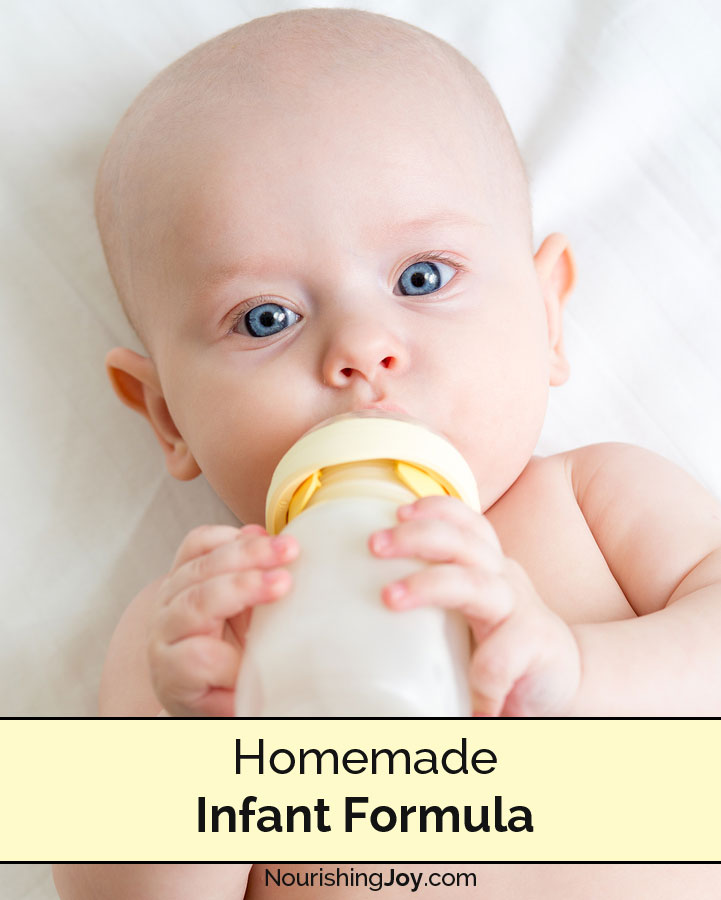

Goat's Milk Homemade Baby Formula Recipe (for supplementation)
Ingredients
- 8 ounces clean water at body-temperature
- 2 scoops (28 g) powdered goat milk
- ½ teaspoon nutritional yeast (for the B vitamins and folic acid)
- 1 teaspoon brown rice syrup (for the carbohydrates), use Lundberg brand if possible, due to their careful testing for arsenic
- 2 teaspoons blackstrap molassas (for the iron and the sugar)
- ½ teaspoon cod liver oil (for Vitamins A & D and balanced omegas), (once a day)
- Vitamin D drops – amount according to brand, optional (once a day)
Instructions
- Mix the ingredients. Place all ingredients in a bottle and shake vigorously to combine. You may also use a small mason jar or pre-mix enough for 2-3 bottles in a blender.
- Serve. Give to the baby right away or store in the refrigerator for up to 1 day. Discard any formula that has been served to the baby but has not been finished.
Notes
Goat's Milk Homemade Baby Formula Ingredients (for supplementation)
8 oz. water at body-temperature
2 scoops (28 g) powdered goat milk
1/2 tsp nutritional yeast (for the B vitamins and folic acid)
1 tsp brown rice syrup (for the carbohydrates)
2 tsp blackstrap molassas (for the iron)
1/2 tsp cod liver oil (for Vitamins A & D and balanced omegas) (once a day)
Vitamin D drops – amount according to brand (optional) (once a day)
Place all ingredients in a bottle and shake vigorously to combine. You can also use a small mason jar or pre-mix enough for 2-3 bottles in a blender.
I also recommend that for the first few days of using the formula, use half the recommended amount of powdered milk and slowly work up to the full amount, especially if your baby hasn't started eating solid food.
For Further Information About Conventional Infant Formula…
- Genetically-modified soy shows up pretty much everywhere – why babies should avoid it
- Mom's Non-GMO Shopping Guide
- DHASCO and ARASCO in Infant Formula (PDF) – from Food Standards of Australia and New Zealand
- Infant Formula Report – from the Cornucopia Institute
- Ingredient Quality, Nutrition Data, and 2 PDF's comparing data from the leading formulas – from Nature's One


Can you make the second recipe but substitute the raw milk with goat powered milk?
If you’re using the formula to supplement, absolutely. However, the reason it’s not advisable to just switch the milks around for full-time use is that they’re not nutritionally identical. If you do switch, you’ll need to add a couple more ingredients to complete the full spectrum of needed vitamins and minerals.
Goat’s milk lacks both folic acid and Vitamin B12. You would need to add in the nutritional yeast for the folic acid and some other source for the B12 – Sally Fallon suggests in Nourishing Traditions to grate raw chicken liver into the mix! Suffice it to say, yes, you can do it, but just do so carefully.
All the best to you and your little one! (I’m assuming you have a little one…) 🙂
If supplementing, could you read the 8oz of water with breastmilk? That would make two servings for my 3 month old. I need to partly supplement when I’m away. My breasts have been anti-pump recently, but I can’t be with my daughter at all times due to work.
No, I wouldn’t mix the formula with breastmilk instead of water, merely because it would provide too rich a drink – far more than a baby needs.
If you’ve got that much breastmilk on hand but still want to stretch it a bit, I would use the breastmilk by itself and then mix up the supplemental formula using water to make up the difference. You get the maximum amount of food for your babe that way while making sure she actually gets all the breastmilk. I’ve had it where a child won’t finish a bottle when it’s a new taste and if you mixed it with breastmilk, you’d end up throwing out some of the breastmilk, which always breaks my heart. 😉 Plus, that way she also gets all the breastmilk first.
Did I understand your question correctly?
You did! Thank you. First night back at work and I have 5oz that took me two days to pump. I’ll have Grandma start with my milk and move on to the supplement after. I cried in the shower for hours because I just couldn’t bring myself to buy commercial formula. Thank you for this!
I am a full-time working mother and then some, I have been EBF (breast milk bottle feeding while at work) for 8.5 months. I am not pumping enough to supply my daughter with 3 bottles/day and am at the point of having to supplement 1 bottle a day (for now). I am in tears at the thought of feeding my daughter the toxic formula that is sold at conventional stores. I notice the recipe for supplementation lacks many of the ingredients for full-time formula. what is the reason for leaving them out? I am also wavering between goat milk and cow milk. Information overload, argh!
Jacquelyn,
I SO understand how you feel! Thank you for sharing.
The supplementation recipe includes fewer ingredients merely in order to make the formula for less money and less time while still providing sufficient nourishment for the babe. Since it assumes that the child is receiving nourishment from other sources as well, it hits the major nutritional necessities, but doesn’t make sure every. single. vitamin. and. mineral. has been accounted for. If you’re only making 1-2 bottles a day, it’s definitely sufficient. If you have to increase the amount you’re supplementing beyond that, however, I would take the time and $ to make the full formula. (It actually isn’t hugely more than buying commercial formula, at least where I live.)
As for goat vs cow milk – if you’ve done your research (which it sounds like you’ve done), then don’t stress over the decision. In fact, go back and forth between the two to see which works better and which your baby prefers. That’s the beauty of homemade formula – you can tweak it to fit your child specifically. 🙂
Many blessings to you and your sweet baby!
Hi there,
I am almost at a point where I am unable to make enough milk for my son. iI do have a freezer stash, however, I plan to use it when I have no milk let, to mix with another choice of milk subsitute to get him use to it and make sure its going to work out good!
My question is about the goats milk powder formula. You say it is fortified with folic acid and vit. B12, so I was wondering why you still add more to it, and also if it is ok just to give to them without adding anything to it?
Our naturalpath also reccommended a very high quality multi-vitamine/mineral supplement when nursing was complete, would this be an okay source to receive those other ingredients without having to add it to the milk?
Thank you
Well, the Meyenberg goat milk is fortified with folic acid and Vitamin D, not Vitamin B12, so that’s why the nutritional yeast is added. I wouldn’t give it plain except for very rare emergency use.
And yes, you can certainly give the multi-vitamin to your sweet son without adding it into the milk, if I’m understanding your question correctly. As long as your child is receiving all the nutrients daily, you can get them into his belly in whatever way works for you. 🙂
Hi,
My 7.5 month old is starting to have too many problems with commercial 6months + formula (she never latched and I ran out of my pumped breastmilk when she was 4 months). As such, I’ve been researching and came across a goat milk formula day before yesterday and made it up yesterday to give her 2 bottles to try in addition to 2 bottles of the commercial formula as I’m a bit nervous to cut that completely out yet. The recipe I found is similar- 2 c goat milk (could only find powder but found fresh today for tomorrow’s batch), 2 c water, 1/4 c whey, 1-2tsp blackstrap molasses, 2 tsp organic maple syrup, 1/2 tsp cod liver oil, 1 tsp extra virgin olive oil, 2 tsp virgin coconut oil, 2 tsp nutritional yeast, 1/4 tsp bifodobacterium infantis, 1 tsp unrefined sunflower oil, 1/4 tsp acerola.
Now, I live in South Africa and some of these things I couldn’t find ( I miss my home Canada with it’s abundant health foods) such as acerola which they told me is discontinued here and to sub with 1/4 tab of 500mg vitamin C. Also I couldn’t find the bifodobacterium on it’s on, I found it mixed with two other paed probiotic strains in powder sachets. And no UNrefined sunflower oil (plenty of refined!). So I made a half batch with all except the sunflower oil and then the 2 slight alterations (vit C and probiotics). Is this recipe sufficient for me to do a full switch for this formula to be full time and lose the 2 bottles of nonsense commercial formula???
I have a friend who’s 4th child couldn’t be nursed past 10 months due to her 5th pregnancy and she gave him just plain goat milk, no formula or additions to the goat milk. I also know of an older grandma who gave her children under 1 goat milk supplemented with molasses for the iron and B vitamins. Please advise as the Weston A Price formula you have above for full time would be even more complicated to make seeing as there is no lactose to be found and not a chance of raw cow milk. Thank you!
Hi, I have been supplementing 1 bottle a day with liquid goat milk, for the past 2 months. I started b/c I had a business trip to go on and needed to make a small stock pile. I then realized that my daughter was moving her bowels every day and much easier than ever before, so I stuck with the 1 bottle a day and I am happy to say she is regular now.
She did have some cows milk protein allergies early on so I cut out dairy and it got better. She will be turning 1 year old in 2 weeks and I am concerned about the switch to cows milk as I will no longer be breast feeding her.
I never added anything to the 1 bottle of goat milk I supplemented with, as she was getting 4 other feeds of BM. What do you suggest I do so she adjusts smoothly?
PS: she loves Meyenberg goats milk, but I can’t afford to give her 21 oz of it daily!
Thanks!
Why do you feel you need to shift her to cow’s milk? Why not leave her with goat’s milk for the time being? Or, why not keep her on the supplemental formula even once she’s eating a full diet of solid food? She won’t need the full feeding of it, so you won’t have to provide the same amount, keeping it more affordable.
Many blessings! 🙂
Can I use the first formula for my yet to be born newborn? I am not able to breast feed at all do to surgery.
No, I would definitely not use the first supplemental formula for a newborn that is being exclusively formula-fed. You could definitely consider the second one – the one from the Nourishing Traditions cookbook – but if at all possible, talk with a naturopath you trust first, as they’ll give you needed insights that apply to YOUR specific situation and make sure your newborn gets the best nutrition possible.
Many, many blessings on your upcoming babe! What a gift. 🙂
My Naturopath told me to use Neocate. This is my fifth child and three of them have had major problems with milk and formula. I am overwhelmed with trying to find homemade formula that will meet my baby’s needs. The second formula by husband is 100% against. Is there a goats milk formula for newborns that you know about other than the liver one?
Jacqueline,
I can only imagine your exhaustion! I certainly applaud you for your intentionality to provide well for your baby. May you and your babe be richly blessed!
Out of curiosity, what specifically about the homemade formula is your husband against? It seems from your question that he’s not against a homemade formula, per se, but something specifically about that recipe. You can make that recipe with goats milk, but you would need to add liver as well to ensure there’s enough Vitamin B12 and folic acid, so no, I don’t know of any other nutritionally-complete recipe.
Also, if your naturopath has recommended Neocate, is there a reason you’d prefer not to use it? Is it because it’s a formula? Is it because it’s nutrient-based rather than whole-food based? Is it because it’s expensive (I don’t know, I’m just theorizing)? Is it because it’s difficult to obtain? Knowing why you’d rather not use it might help you narrow in on what is important to you in a homemade formula as well, especially if your husband has some hesitations.
Again, many blessings to you on this journey.
Thank you for responding so quickly!! 🙂
My husband is nervous about the liver part and is this is all foreign to him as this is his first baby biologically. Because the liver is a place where the toxins go, is concerning.
My first husband passed away. I guess when it comes down to it… Store made formula is not fresh and is sitting on shelves for how ever long and I have no idea what is in it. Whether it has GMO ingredients, milk based, will it come up as a recall because of contamination… It just isn’t sitting right with me. As for Neocate, I would use it. The price is not my biggest concern but our baby’s nutrition and well being. In Canada, I believe it has to be obtained through a prescription.
I had a breast reduction when I thought I wasn’t having anymore babes. I regret that decision as two of my children suffered greatly on formula!!!. One thing I read that made me nervous is that Goat’s milk and that liver formula puts baby’s at risk for kidney failure. 🙁
Blessings,
Jacqueline
I have a 1 year old who has been EBF but now with him eating 3 meals a day of normal people food my supply has dwindled. I like the powdered goats milk recipe but my question is can you replace the brown rice ingredient with something else? My son has a rice intolerance and can not have any rice products at all. I am not necessarily at the point of needing to supplement but I have started working again and worry if my supply does dry up I want him to still have nutritional options for drinks besides just drinking water all day. I tried the straight goats milk and he wasn’t much of a fan so I hope this will maybe be an easier transition.
Chelsea,
My first thought is to substitute barley malt syrup for the brown rice syrup, provided your son doesn’t need to avoid grains as well. It’s a slightly stronger flavor, but delicious (and hopefully your son would think so too! 🙂 ) Eden Organic makes an organic barley malt syrup that is excellent. http://www.edenfoods.com/store/product_info.php?cPath=26_50&products_id=104050
In fact, I may revisit the recipe and make barley malt syrup the preferred sweetener…. I’ll have to think on that, but in the meantime, definitely give it a try!
Blessings!
Thank you! So far no known reaction to Barley so we will give that a try:)
I’m so glad I saw this blog post! I have been struggling too with late afternoon through evening feedings as my baby seems starving and wails as he pulls away from my breast because he’s frustrated from not getting enough. It feels like I have little to give him by late in the day and he can’t get satisfied. I have been wrestling with what to do but thought maybe I need to supplement with formula at night after I try to nurse him as much as I can. It’s so comforting to know someone else has had to do this as well…Csn you tell me how you go about supplementing with formula? How do you know how much more to give your baby and how much/how often do you offer it at night? Is it going to affect my supply? ( though that seems like a moot point when I already don’t seem to have enough). Do you first have your baby nurse a little and then give a little formula to finish? Thanks!
It can vary. When I was first starting to supplement, it worked best to nurse first and then give 2-3 ounces of the homemade formula afterward, making sure my baby had as full a feeding as possible at each breast. As time went on, it tended to fall into a pattern of nursing, then do formula at the next feeding, followed by nursing at the next feeding. Just see what works for you and what satisfies your baby. 🙂 And yes, it will affect your supply, but nursing first will help that and keep it as stable as possible.
Blessings!
Ok, thank you!! That helps a lot!
I bought the ingredients for the goats milk powder recipe. Once you make a bottle how long is it good for and can it be reheated?
I *think* the instructions on the Meyenberg can of powdered goat milk say that milk should be drunk within two days once mixed, but double check that, as I don’t have the can in front of me. I usually make sure any pre-mixed milk is drunk within a day. And yes, I’m willing to reheat it once. In fact, sometimes I mix a day’s worth of bottles at once, put them in the refrigerator, then reheat them by placing the bottle in warm water.
Thank you so much!!
Hi, My daughter is 10 1/2 weeks old and I have not been able to breastfeed, so I have been pumping and bottle feeding. My supply went down over the past 6 weeks, so we started to give her homemade goats formula that my naturopath recommended as supplement to the breastmilk. My supply has gone down even further, so my daughter is getting about 14 oz of breastmilk and 14 oz of homemade goats formula every day. At this point it’s 1/2 & 1/2, so I’m not sure which recipe should be followed. Currently we are giving her homemade formula made of powered goats milk, spring water, maple syrup, cod liver oil, infant probiotic, multi-vitamin, and vitamin D3. I dont believe there is enough folic acid or B12 in her diet from the Goats milk formula, but is she getting all she needs from the breastmilk? What do you consider supplementation? I want to ensure she is getting the proper nutrients. Thanks!
Christina,
First of all, huge hugs to you and your daughter! It’s never an easy journey to be figuring all this out, especially when they’re so young. 🙂
As for the recipe, the recipe your naturopath gave you looks great. Since your daughter is still getting at least half breastmilk, I would stay with that recipe and perhaps once or twice a day add nutritional yeast to the recipe. Obviously, double check that with your naturopath the next time you see him or her, but that would be my recommendation based on personal experience.
What you’re doing sounds right on track. Many blessings to you as you nourish your little one with all the love you’re showering on her too! <3
Kresha, thank you so much for the encouragement, it has definitely been stressful not having the supply I hoped for and desperately not wanting to give our daughter store bought formula. Also, thank you for the advice, we have been thinking about adding nutritional yeast the last couple of days, so we will move forward with purchasing some. Thanks again!!!
Hi! My daughter is six weeks old and I am breastfeeding but unfortunately have been supplementing with formula due to low milk supply&only being able to produce from one breast. I am able to give her one ounce of breastmilk every feeding with 3 ounces of formula. Problem is the formula Holle 1 organic seems to be bothering her and wanted to switch to Goat milk. Would I be able to use the supplement recipe if shes only getting one ounce of breast milk per feeding? Also the cod liver oil says once a day. So if more then an 8oz supply a day is needed would I not be adding the cod liver to the next batch. Sorry if this is a dumb question but I really want to be certain I make this right. Thanks!!
Not dumb at all! It can be so overwhelming in those first few weeks to figure out exactly what your sweet babe needs. 🙂
If she’s only getting one ounce of breastmilk at each feed (Yay! One ounce! Yay!) I would NOT use the supplementation recipe, but go for the full-time recipe. If it makes it easier, make a full batch every day or two in the blender, pour it into individual bottles, and just warm them when you need them. (I found that a wine cooler, either ceramic or marble, makes this super easy, since it’s tall and narrow. Just add warm water, add the bottle, and let warm for 2-3 minutes. I see wine coolers regularly at my local thrift stores for $2-5.)
And to clarify about the cod liver oil, yes, if you’re making the supplementation recipe, you just add the CLO to one bottle each day and skip it in the others.
I wish you all the best as you continue to nurse as long as it’s possible and as you continue to nourish your daughter in all the wonderful ways that you can!
Hello, I’m glad I found your site! Only yesterday I came across the Mt Capra Powdered goat milk formula. I went out and bought the olive oil, coconut oil, unsulphured molasses, turbinado sugar, vitamin drops n probiotic. However I was not able to get the Mt Capra powder milk so I substituted raw goats milk instead –4 oz goat milk with 4 oz water.
My question is, is this homemade formula good for full substitution? And did I substitute the raw goats milk correctly for the powdered one? I’m still breast feeding full time but my supply is low some days and in evenings, my baby is 3.5 months old but I just want to be prepared for when I don’t have enough milk or I can’t continue to breast feed. Will this formula work as a sole source of milk for my baby? Do I still need to add yeast and B12 if using raw goat milk? If so how else can I get B12 without using liver? My husband is against that part and I’m hesitant with it too. Any help would be greatly appreciated! God Bless and thank you! 🙂
Oh and also do I need to put whey in the formula if I’m using raw goat milk? Thank you!
Yes, you would still need whey – but you could use whey either from cow or goat yogurt, whatever is easiest. 🙂 And as you asked in another question, no, I wouldn’t use powdered whey, as the proteins get damaged in the processing. Definitely go with fresh. 🙂
Libby,
I’m so glad you’ve found us! Welcome!
So, I’ve been thinking for while on your questions, merely because I don’t think I’ve fully understood what you’re asking and I wanted to answer adequately.
You mention liver. I’m assuming this is because you have read the “Goat Milk Variation” version of the Nourishing Traditions recipe, which requires a bit of frozen chicken liver to be grated into the milk – or is it regarding cod liver oil? Again, I’m assuming the former – please correct me if I’m wrong.
As I mentioned in a comment to Christina recently, which can be found either above or below this comment, while I definitely understand the hesitations you and your husband have, please know that liver is actually one of the foods that is truly excellent for nursing women and young children. While the liver does *filter* toxins, it doesn’t *store* toxins and is a concentrated source of vitamins and minerals in bio-available form.
I say this merely to encourage you to not be afraid to use it – I agree it does have a “ick” factor that takes some getting used to when grating it into milk, but it really is the best place to get (and give) so many of the vitamins and minerals we need in a way that our bodies can easily use. Also, since these recipes were carefully developed by whole-food loving scientists, I fully trust that their recommendation to include chicken liver is the best way to provide the B-12 your baby needs when it isn’t being provided by other ingredients, as it is in the cow’s milk recipe. And while I can suggest other sources of B-vitamins, I am not qualified to suggest that any other ingredient will provide it in the same symbiosis that chicken liver does, so either fortunately or unfortunately, no, there is no better way to feed your baby a goat’s milk formula than to include the liver.
(Now, I will make one caveat – the recipe calls for *raw* chicken liver, which has all its enzymes still intact and sort of disintegrates in the milk when grated finely. However, I personally would feel comfortable cooking the liver first as you get used to the idea. You would still need to freeze the liver after cooking in order to grate it finely enough and the cooked liver won’t disintegrate into the milk quite as nicely, but it might be a way to have a happy medium with using liver. I will say again that this is merely a personal decision and for legal reasons I must state that I am not advising you to do so nor can I guarantee that a cooked liver will provide the same array of enzymes and vitamins, but I’m merely mentioning what I would consider when faced with the same decision.)
And as for using raw milk instead of powdered milk – you don’t need to add any additional water. The water here is merely to reconstitute the powdered milk, so if you’re making a four-ounce bottle, just use 4 oz. of goat milk, add in the supplements from there, and you’re good to go.
So, did I answer everything and in helpful ways? If not, please let me know. I’ll respond in a more timely manner. 😉
Hi
Thanks for the great tips. I want to start my 5 week old on the nourishing traditions recipe. I was wondering can I replace clo with organic flaxseed oil? Also can I store it in plastic bpa free bottles? Also can I use vit c tab instead of acerola? And just use whey and kefir instead of extea probiotics? Thank you
Hi, Colette.
Let’s see…. no, I wouldn’t make any of the substitutions you have suggested, unfortunately, if we’re talking about on an on-going basis rather than a one-time in-a-pinch kind of deal. That’s merely because this recipe was developed not only with what each ingredient provides for a very young baby, but how the ingredients synergistically provide the nourishment your baby needs. And especially when your baby is so young, I wouldn’t differ from the recipe much at all.
As for the plastic bottles, I’m assuming you would only be storing one day’s worth at a time (meaning, you’d make one big batch each morning and pour it into 6-8 bottles to serve through day)? If that’s the case, I would say, do whatever you’re comfortable with – I’ve used glass, plastic, and stainless-steel and my personal favorite were the glass ones. The only two cautions I would have with plastic are:
1. Be sure you’ve boiled and cooled them a number of times before use, just to reduce the off-gassing of any residual toxins
2. If you’re going to be using them long-term, just know that sometimes the scent of the cod liver oil will permeate the plastic and don’t count on using the bottles for other drinks a year from now…. 🙂 Sometimes it’s fine – I’ve just have varying experiences with various brands of bottles.
Many blessings!
Thank you very much for the fast reply. I forgot to ask. How is this sterilised? If I make whey do I need sterile the formula. Sorry sounds silly lol. Also im waiting a couple days on acerola can I omit it for couple days or would I harm my baby. Who is 5 weeks old. How does it work storing it for days out?
Hi, Colette!
This isn’t sterilized (pasteurized), as the raw milk has natural enzymes and probiotics that you want to populate your baby’s gut. However, if that bothers you, feel free to pasteurize it gently, as heating it on the stove won’t harm the milk in the ways that commercial pasteurization does. To do so, merely place the milk on the stove and heat over low heat until it reaches 180F and hold it there for 5-10 minutes.
I wouldn’t heat the whole formula this way, however, as you don’t want to denature the whey or the added probiotic strains. (So, no, once you add the whey, DON’T pasteurize the formula.)
As for the acerola, if it’s just a couple of days, go ahead and make the formula without it. Just start adding it as soon as you’re able.
Storing makes for a convenient way to make this formula without having to mix it up every time, which can be laborious. However, you don’t want to mix up more than 1-2 days’ worth at a time (I recommend only one day at a time), as you want to give the freshest formula possible to your baby. The easiest way (that I know of – if anyone else has good tips to share, please do!) is to make one batch fresh each morning, as described in the recipe. Pour into as many bottles as you will need for the next 24 hours, then place in the refrigerator.
When it’s time to feed your baby, remove one bottle from the fridge, heat it gently (I do this with a wine cooler – fill with hot tap water and set the bottle inside it for about 5 minutes), then you’re ready to go! 🙂
I hope all that helps!
Yes thank you that’s wonderful. I was just wondering if im out of the house should I use a cool bag and store bottles in that?(so far I been using organic formula pre made!) If so can I keep that a few hours like that? Otherwise im not sure how I can feed her out the home 🙂
Hello Kresha!
I wrote you you a couple of weeks ago about supplementation and now my supply is even less, so I need to change to the second recipe.
I am wondering about the second recipe for full formula feeding. Can I use goat milk powder or should I use goats milk? I have cows milk allergies and really don’t like the idea of feeding it to my daughter. I know I can get goats milk, not sure I can get Raw which scares me. I have consumed raw dairy, but worries me for my baby. If I can use goat milk powder, how much do I use?
If I use goats milk, Then what would I use for whey and cream? Would I have to use cows milk?
Also, The idea of chicken liver doesn’t make me all that happy. Is there a substitute for that? Liver is one of those filtering organs I heard we should not eat. Also, the recipe says to shave frozen chicken liver. Have you tried it? Does it just dissolve?
Thank you for your help, again!!!!!
Christina
Hi, Christina.
Okay, you address a number of questions, so I’ll number them here to make sure I get them all! 🙂
1. If you are going to use goat’s milk in the full-formula feeding recipe, I would recommend using fresh goat’s milk rather than powdered and there are good instructions about any substitutions at the Weston A. Price site –> http://www.westonaprice.org/childrens-health/recipes-for-homemade-baby-formula#vgmf (obviously, you’ve read this article since you ask about liver, but more about that in a minute). You may certainly use pasteurized milk if raw worries you – just be sure not to use ultra-pasteurized milk.
2. If you use goat’s milk, you can get the whey from goat milk yogurt and the cream from extra goat milk (it doesn’t product much, if you let it still for a day or two, you can skim off a bit). Perhaps other readers who have used goat milk could chime in with what they’ve done.
3. As for the liver, liver is actually one of the foods nursing women and young children should be eating often rather than avoiding. While the liver does *filter* toxins, it doesn’t *store* toxins and is a concentrated source of vitamins and minerals. (Read more at Nourished Kitchen.) I say this merely to encourage you to not be afraid to use it – I agree it does have a “ick” factor that takes some getting used to when grating it into milk, but it really is the best place to get (and give) so many of the vitamins and minerals we need in a bio-available form. And yes, in shaving it finely, it sort of just disintegrates into the milk, similar to dissolving. I have found just using the smallest holes on a box grater or handheld grater works is sufficient, and it is necessary that the liver is frozen, as otherwise it just kind of crumbles.
I hope that helps!
Why did my comment get deleted twice? Did I not post correctly?
Libby,
No, your comments were not deleted. You asked good questions and they merely took awhile to post because I was researching alternatives to liver, since that part of the recipe concerns you. I’m sorry for the delay – when I receive hundreds of e-mails and comments a day, it sometimes takes me a while to respond. {hugs}
anything we can use in place of cod liver oil? price-wise how does this compare with earth’s only? i still nurse my 16 m/o but he’s a picky eater quite small so i really want to continue formula.
Well, the cod liver oil provides the right balance of Vitamins A & D, as well as is high in the fatty acid, EPA. Other oils don’t have these same ratios, so no, there’s really no adequate substitute for the cod liver oil, except perhaps some other oily fish oil.
As for price, I found making the supplementary formula was comparable to both Baby’s Only and Earth’s Best. Where I live, buying one of those commercial formulas or making the supplemental recipe (the one with the powdered goat’s milk) are about equal. When I was making the full-time formula, the cost was only a few dollars more per week, so still not outrageous. (Well, the cost of any of them compounded over time is outrageous, but all in all, none of the options cost exorbitantly more than the others.)
I hope that helps!
Does Baby Only have a formula for infants bc all I have been able to find is for toddlers?
Yes, all Baby’s Only formula is labeled as being for toddlers. According to the company, this is because they want to encourage exclusive breastfeeding for at least the first year of life. However, the formula may absolutely be used for infants. They encourage you to talk to your doctor before using it with an infant (again, to encourage breastfeeding and to address any issues that may be getting in the way of exclusive breastfeeding), but it is formulated so that infants may take it. If you intend to use it with a newborn or very young infant, I would contact the company for more information, but for any other infant, it should be fine.
Many blessings!
Okay thank you. My son is three and a half months old and my milk supply has decreased by half since I started back work and when my frozen stock is gone ill have to do something but do not want to give regular formula! Thank you again!!
how do you make a Homemade liquid whey and the cream to make cow base baby formula? I do have raw whole milk from a farm.
Thank you
Meky,
The easiest way to get cream is to first skim the cream off the top of the milk. For the whey, then culture the remaining milk into yogurt, place the yogurt in cheesecloth and strain it over a bowl as the whey drains off. You’ll end up with enough whey for several batches (plus yummy, thick yogurt), so it’s worth the time. 🙂
I hope that helps!
Thank you for sharing! I am looking to supplement for my son and I just made my first bottle. Is it supposed to be brown from the blackstrap molasses or were my amounts off? I’ve seen other similar recipes that use the same amount of molasses but for a much larger batch. Could it be cut back at all? Thank
You!
Yes, the mixture is quite brown. It can be surprising the first time you make it. 🙂
That said, I’d love to see some of the other recipes, as I was under the impression that this recipe has LESS molasses than others – that’s pure curiosity, of course. 🙂 And yes, you can cut it back, but it is what provides the iron, so I would recommend making that decision according to what else your baby is eating.
I hope that helps! 🙂
Thank you for your response! That is good to know. The Mt. Capra powdered goat’s milk formula, for example, calls for 1/8 tsp of the molasses per 8 oz bottle. It does have other ingredients however, which I guess would make up for the extra iron. I asked about the molasses bc I thought that maybe that was what my son didn’t like, but I think it’s the cod liver oil. Could I use an infant probiotic to substitute for the missing vitamins from the oil? I only plan to give maybe 1-2 bottles per day. I BF him primarily and he gets puréed fruits and veggies for lunch and dinner. I haven’t introduced any meats yet. (Just wanted to give you a better idea of what he eats so maybe I don’t even need the cod liver oil). Thank you so much! Great recipe 🙂
Learning, comparing, trying to get this all clear in my head. I’m curious how the Mt. Capra recipe compares to the supplemental recipe above. Coconut/olive vs. cod liver oils? No added vitamins? Is the cod liver palatable to infants? I confess, I’ve yet to try it myself. Thank you for the recipes, and any added insight.
Yes – comparing is good! 🙂
First, cod liver oil. Yes, definitely palatable for a baby. I have yet to see an infant who even bats an eyelash at the taste.
As for the choice of oils, I include cod liver oil rather than coconut and olive largely because this is a *supplemental* recipe and if the baby is still receiving breastmilk, then the most important supplement would be the balanced omega fatty acids and Vitamins A & D found in cod liver oil. Obviously, the full recipe has all three (cod liver oil, olive oil, and coconut oil), but for a supplemental recipe, I found in order to keep cost down, just making it with cod liver oil was sufficient.
This supplemental recipe also doesn’t include probiotics or multivitamins, which the Mt. Capra recipe does, again, merely because I’m assuming the baby will receive those from the mother and they’re not crucial for a part-time supplementation.
So, I hope that helps! 🙂
Can the 1/2 tsp of CLO be substituted with the CLO/high vitamin butter oil blend from Green Pasture? If so, would the quantity remain the same?
Yes, it can most definitely be substituted and I would think the amount would be the same, especially if it’s for an older baby or toddler. If you have any concerns, I would contact Green Pastures directly. Personally, though, I would make a 1-to-1 substitution. 🙂
I am hoping that you can help me! I have a 4 month old who has to have her milk fortified for higher calories due to a heart condition. She only consumes 18-20 ounces on a good day. All of the liquid she gets is breastmilk but I add formula to it for the calorie increase. I have been using earth’s best but after doing some research I do not want to use any commercial formula anymore. I want to try the Mt. Capra goat milk. Since she is getting all the normal nutrition though the breastmilk, would it be okay to just add the right amount of goat milk to increase calories or should I add anything else to it? I plan on getting a special multi-vitamin for her as we have a gene mutation and need our folic acid and b-12 methylated to be able to process them. I already add high quality probiotics to most of her bottles. I believe my milk is already pretty fatty on it’s own. So with the breastmilk, adding mt. capra and probiotics and a powdered multi-vitamin/mineral do you think that is enough for her? Thanks!
That’s a really great question, but unfortunately I am utterly unqualified to answer it. You have very specific needs that need to be discussed with a practitioner you trust and who can give you good information based on your entire health situation. Do you have a naturopath or another practitioner who will listen to your concerns and really discuss them with you? In general, yes, I would lean toward the goat milk powder to bulk up calories and yes, in healthy infants, what you have described seems sufficient. However, due to the gene mutation and heart condition you mention, that route may not be the best option for you, so again, I really urge you to talk to someone who might know the best way to nourish both your babe and YOU!
Many many blessings!
I’ve read through all the comments and don’t think my exact question has been answered so here it is: Would the supplement recipe be okay for all feedings for my six month old? I’m just really confused about the whole thing and I have easily found those ingredients, but not the ingredients for the second recipe.
Thanks!!
No, the supplement recipe is not sufficient for all feedings for your six month old – it’s truly a supplemental recipe. Perhaps after a year if the baby is eating mostly solid food, but not at the time when they’re just starting to be introduced to solid foods and are still fully relying on breastmilk or formula for their full nourishment.
You can definitely source all the ingredients for the second recipe individually, but the easiest way to get all the ingredients all in one fell swoop is through this company, who has put together this package specifically for this purpose: http://www.radiantlifecatalog.com/product/HOMEMADE-BABY-FORMULA-INGREDIENTS/superfoods-supplements
Does that help? Blessings to you and your babe!
Can the first goats milk recipe be used to supplement breast feeding? My son is 2 months
Yes, absolutely. That is exactly what it has been designed for (assuming that your son is receiving at least half breastmilk and half homemade formula. If your baby needs to use formula for more than half of his food intake, I would use the second recipe.)
The best to you and your baby!
Can recipe 1 be pre-batched and frozen for later use? And how many days would a fresh batch be usable for? My 9 month old is EBF (and some solids), but I am going out of town for 3 days and looking for a supplement to frozen breast milk.
Thank you,
Jennifer
Either of these can be mixed and frozen, but honestly, one of the main reasons I developed the one with goat’s milk was to have a “real food” infant formula that was pretty much as easy as mixing conventional-formula, so if you show a caregiver how to mix it, that would be much easier than them having to thaw pre-mixed batches.
However, for the “full” recipe, it uses fresh milk, so it will stay fresh as long as the milk typically would, although I usually serve it with 2-3 days. As for freezing, you can freeze and thaw exactly as you would breastmilk.
Does that help?
Hi there. I was thrilled to find this after a horrible breastfeeding roller coaster for six months. Sometimes she wants breast, sometimes she wants bottle. After a while my milk supply has pretty much depleted because I never knpnow when she wants what and don’t have a reserve and in a panic to make my screaming baby a bottle of guilt-riden :p store bought formula, she’d finally pass out and so would I and I’d forget to pump. While I’m working to bring it back up again I hope to use the first recipe. I was so excited when I purchased everything and came home to blend up a bunch and freeze while grandma had the baby (I can barely make a two ingredient similac bottle without getting frazzled). But I became discouraged by the very strong fishy smell, I’m just so worried she will refuse to drink it because of that. I’ve found her to be picky even with normal formulas. I guess at this point I have to wait and see, but if she does refuse it, I know you’ve said many times here that there is really no replacement but any small chance there is a less smelly brand that you’re aware of?
Y’know, I myself have been offput by the smell occasionally, especially when you’re balancing the cod liver oil and the molasses and the brown rice syrup – all of which have distinct smells. But not a one of my babies ever even blinked an eye at it, even when I first introduced it. Not to say others haven’t, but I wouldn’t let it deter you. 😉
And also, just a side comment, have you SMELLED conventional formulas? In my opinion, they smell FAR worse than this homemade concoction. Even though the homemade version smells strongly, at least it smells *natural*! Conventional formula somehow always smells metallic or something to me…. not that that will make a difference, per se, with your daughter, but it’s just my two cents.
Good luck!
Hello please help!!:) I have 2 month old twins and I’m producing enough breast milk for halk of there feeds and having to top up with formula 🙁 i really hate giving them commercial formula! I want to know if the cows milk or goats milk is safe for 2 months old? I read everywhere not to feed a baby cows milk intell 12 months old dt digestion and possible liver failure. Also i cant get raw milk so will be making kefir with it. Thanks
First of all, kudos to you for wanting to make your own homemade formula – that’s a major and wonderful commitment when you have twins!
Second, I’ve been mulling over your comment for quite some time, as there’s a bit of truth and a lot of falsehood in the whole liver failure debate. However, while I am passionate about this topic, I would absolutely recommend you talk to a naturopath in your area who can advise you better for your situation and talk you through how cow’s milk and goat’s milk will affect YOUR babies. We’re talking about specific advice that will affect the long-term health of your babies, so this is important stuff. 🙂
If you don’t have access to a naturopath, I would highly recommend sourcing out Baby’s Only formula as a commercial formula. It’s only available in the US and I’ve reliably been able to find it in pretty much every health store or natural food section of some supermarkets (like Fred Meyer) I’ve been to, or you can order it via Amazon. The link is in the article above.
MANY blessings to you as you nurture and raise these two new precious treasures!
Aloha! Our precious daughter was born 3 weeks early in April and also born with Down’s Syndrome. She was hospitalized for the first 3 weeks and given BM I had pumped but got nipple confused. Needless to say BF has been difficult, she doesn’t stay latched on long enough and my supply is next to nothing now. Pumping is becoming more difficult due to family life (large family/homeschooling). Is there a powdered goat’s milk formula I can make without the raw livers (maybe supplement that vitamin in another way) that you can recommend? If not, what is your recommendation for OTC formula? Thank you so much.
There is no raw liver in either of these recipes (there is in the beef-based infant formula that’s in Nourishing Traditions), so are you wondering if you can skip the cod liver oil? I don’t know of any other supplement that would provide the same nutritional profile, so I would definitely recommend keeping it.
As for OTC recommendations, my top recommendation (by far) is the Baby’s Only that I mentioned above. As a very far second, Earth’s Best is an acceptable substitute if you don’t have access to Baby’s Only.
Many blessings to you in this newest journey. 🙂